> ## Documentation Index
> Fetch the complete documentation index at: https://docs.accessowl.com/llms.txt
> Use this file to discover all available pages before exploring further.
# OpenAI ChatGPT
AccessOwl integrates with OpenAI ChatGPT to provision and deprovision user access in your ChatGPT Business or Enterprise workspace.
## Capabilities
AccessOwl creates user accounts with the specified roles/permissions during access requests.
AccessOwl removes members from the workspace during access revocations.
## Prerequisites
* **Owner** access in your ChatGPT Business or Enterprise workspace, so you can invite the integration account.
## Setup
Either add a new application or open Applications and click the +-symbol, then continue.
AccessOwl shows you the integration account's email address. In ChatGPT:
* Open **Workspace settings** and go to the **Members** tab.
* Click **Invite member**.
* Enter the integration account's email address.
* Set the role to **Owner** and choose a seat type.
* Send the invite.
The integration account needs Owner because only Owners can change member roles and seat types in a ChatGPT Business or Enterprise workspace. To provision users with the correct role and seat type, the integration account must hold Owner permissions.
## FAQ
No. The **ChatGPT** seat already includes Codex, so anyone on a ChatGPT seat gets both. You assign one seat type per user, and "ChatGPT" is the one that covers both products. On June 24, 2026 OpenAI removed the separate seat type on the Business plan, so depending on your plan you may not see a seat type to choose at all, and provisioning a ChatGPT seat then provisions ChatGPT and Codex together.
AccessOwl supports both seat types OpenAI offers:
* **ChatGPT**: includes both ChatGPT and Codex.
* **Codex**: Codex only, billed pay-as-you-go.
Only one seat type can be applied per user, so select the one that matches the access you want. For most users that is the ChatGPT seat, which already covers Codex.
## AccessOwl in ChatGPT
AccessOwl is also published as an app inside ChatGPT. Once connected, anyone in your ChatGPT workspace can ask ChatGPT about the SaaS apps available in your organization and submit access requests directly from a ChatGPT conversation.
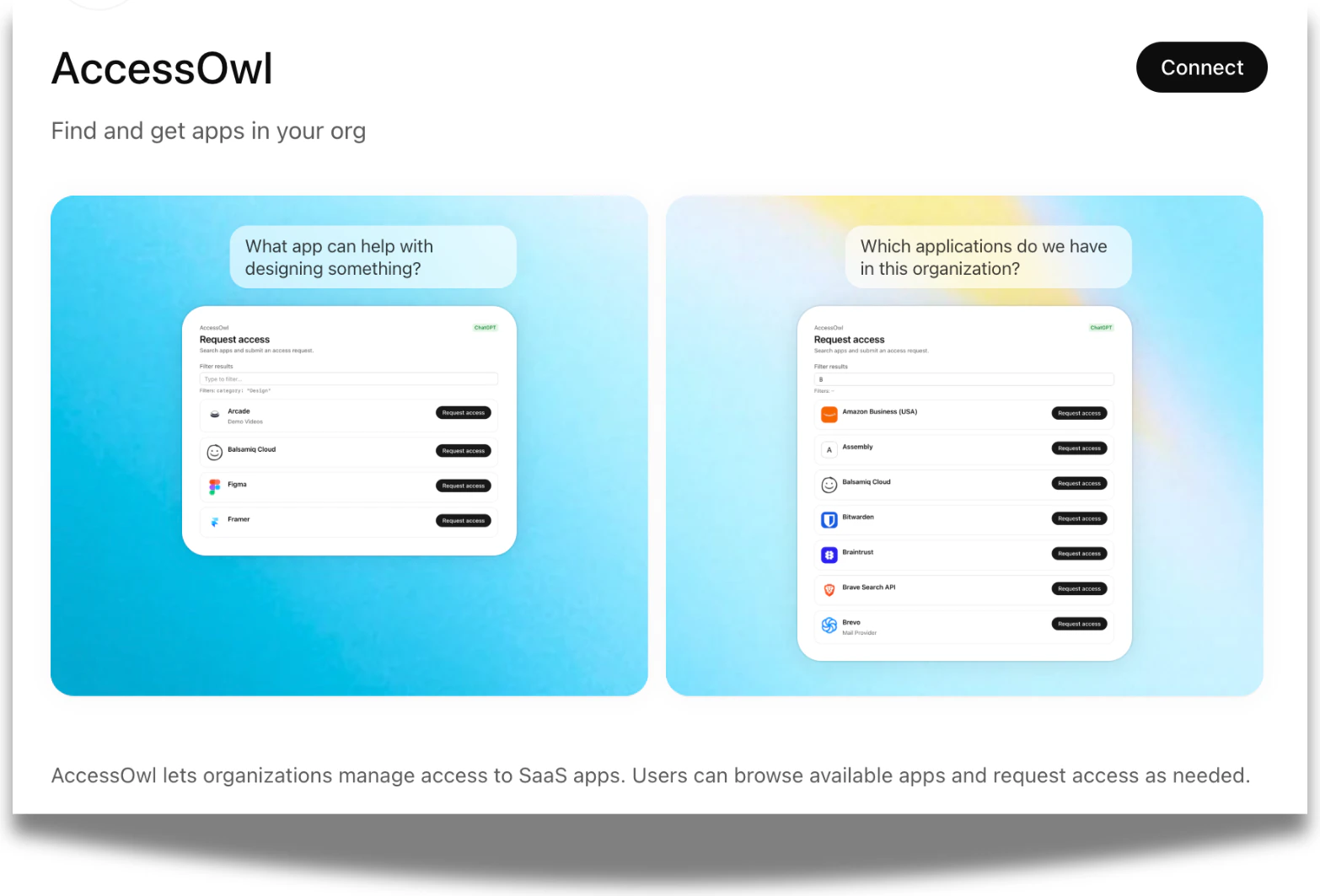 Example prompts:
* "What app can help with designing something?"
* "Which applications do we have in this organization?"
### Connect AccessOwl in ChatGPT
In ChatGPT, open **Settings** > **Apps**, or use the **Apps** entry in the sidebar.
Search the directory for **AccessOwl** ("Find and get apps in your org").
Click **Connect** on the AccessOwl app page and complete the authorization flow to link it to your AccessOwl tenant.
Example prompts:
* "What app can help with designing something?"
* "Which applications do we have in this organization?"
### Connect AccessOwl in ChatGPT
In ChatGPT, open **Settings** > **Apps**, or use the **Apps** entry in the sidebar.
Search the directory for **AccessOwl** ("Find and get apps in your org").
Click **Connect** on the AccessOwl app page and complete the authorization flow to link it to your AccessOwl tenant.