

How Spend Management Works
Spend Management has three parts that build on each other.- You record costs and contract terms on each application. Cost per user, total cost, billing interval, currency, contract dates, and notice period live on the application itself, next to its owners and access data.
- You import actual payments as a CSV. Export transactions from your accounting tool, bank, or card provider, upload them to AccessOwl, and AccessOwl matches each payment to one of your applications.
- AccessOwl surfaces the figures where decisions happen. The cost per license appears on access requests, upcoming renewals are collected in the Renewal Calendar, and imported payments are shown as a spend breakdown over time.
What You Can Do
- See the price before approving a request. Requesters and approvers see the cost per license in the Slack request and approval flow, so the person approving knows what a seat costs.
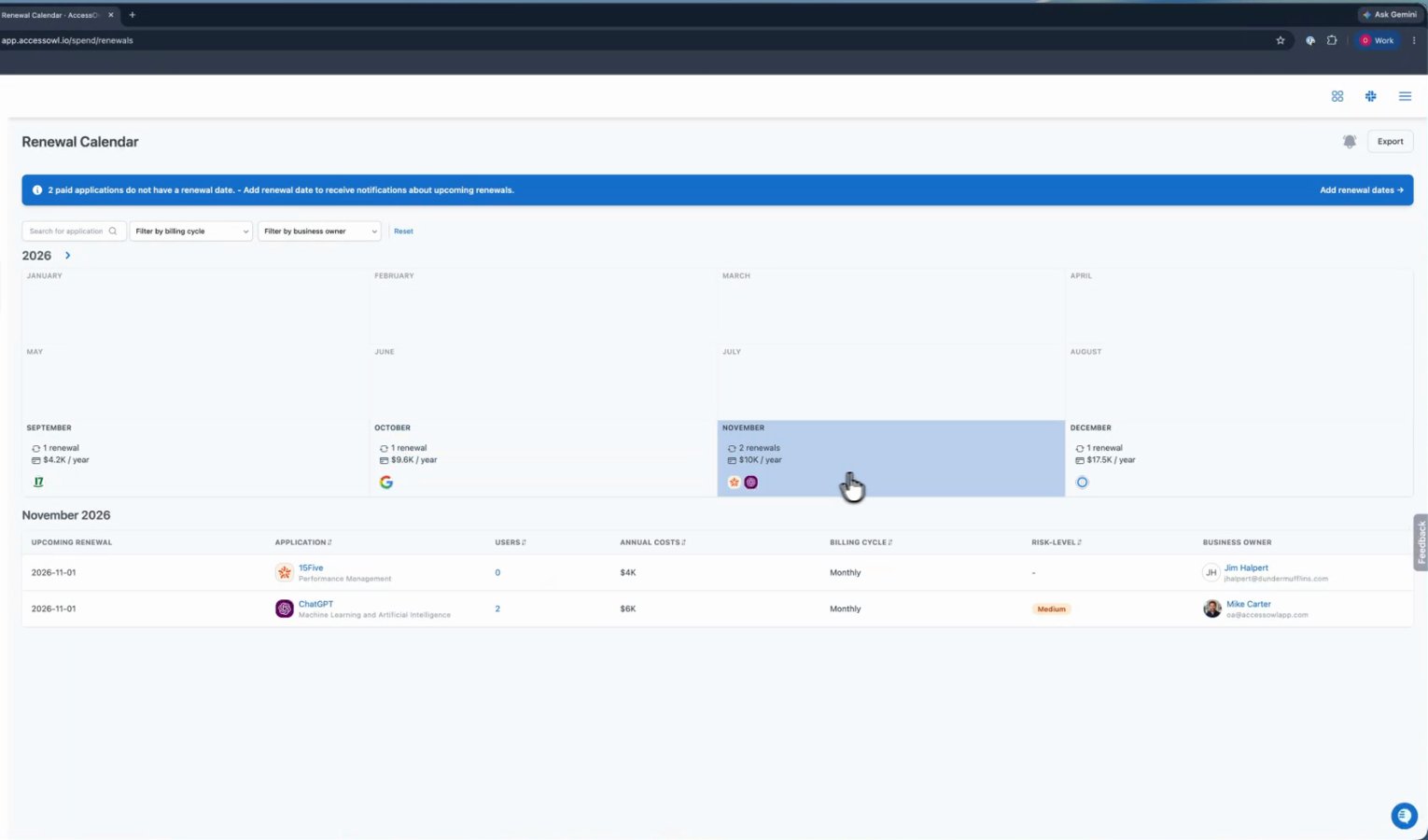
- Never miss a renewal. Business Owners are reminded in Slack before a contract’s cancellation deadline, and the Renewal Calendar gives a month-by-month overview of upcoming renewals across all applications. See Renewal Reminders and the Renewal Calendar.
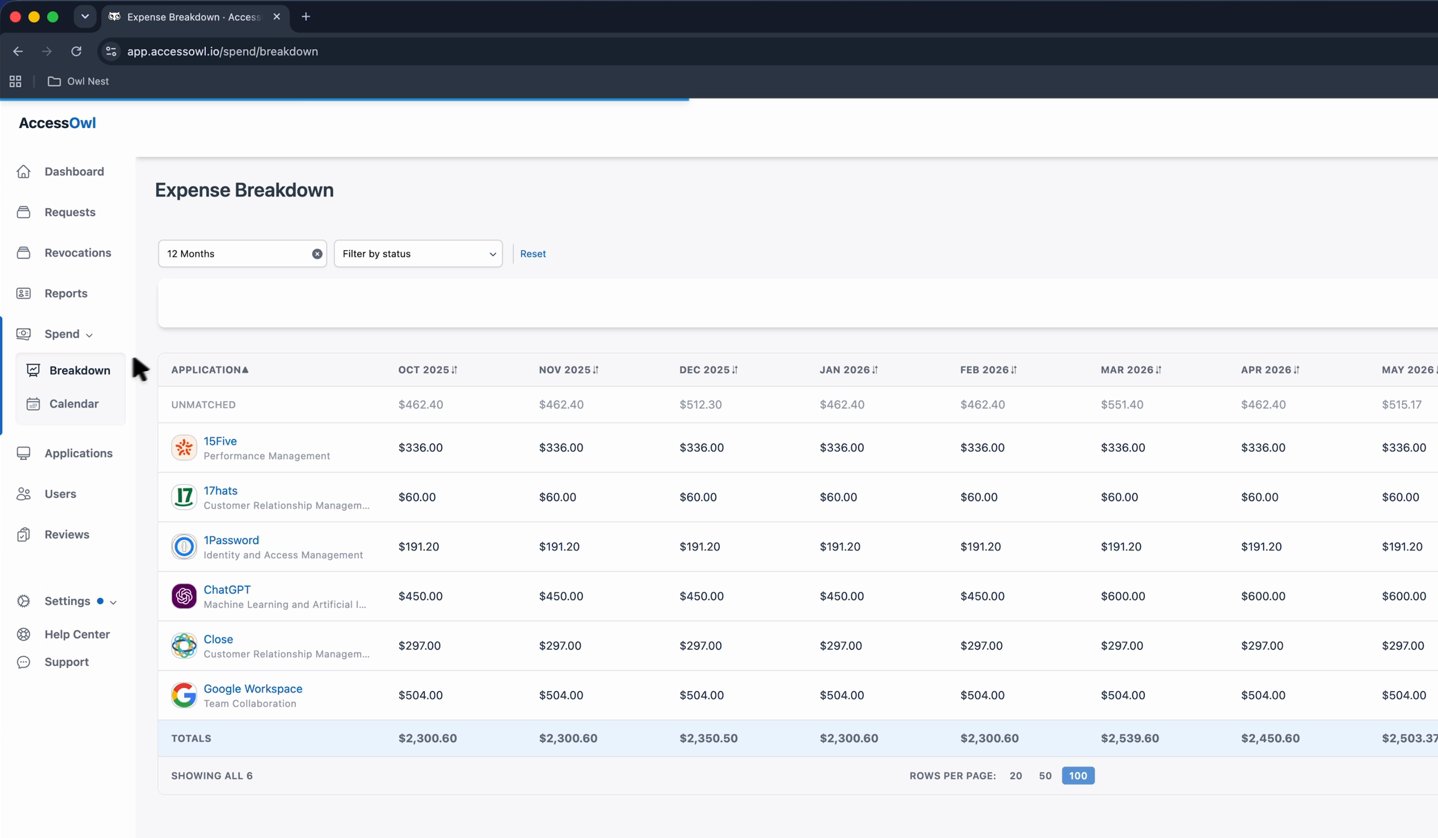
- Track spend over time. Imported payments are broken down month over month by application and category, with the last 12 months shown on each application’s page. Click a number to see which payments it is made of.
- Export your inventory with costs. The Applications CSV export includes each application’s cost figures. See How do I export a list of applications?
Where the Cost Data Comes From
AccessOwl does not detect prices. Shadow IT discovery tells you an application exists, but what you pay for it and on which terms comes from you. There are two ways cost data gets into AccessOwl.Entered by Hand on the Application
Open the application, click Edit, and switch to the Spend tab. The tab has two cards. Contract holds the terms that drive renewals:- Interval (required), how often the contract bills and renews
- Start / Renewal Date, the date the current term started or last renewed
- Contract End, optional, for fixed-term contracts
- Notice Period, how long before the renewal you must cancel, from one week to three months or a custom value
- Currency
- Total Costs, what you pay for the application per interval
- Cost per User, what one user costs per interval
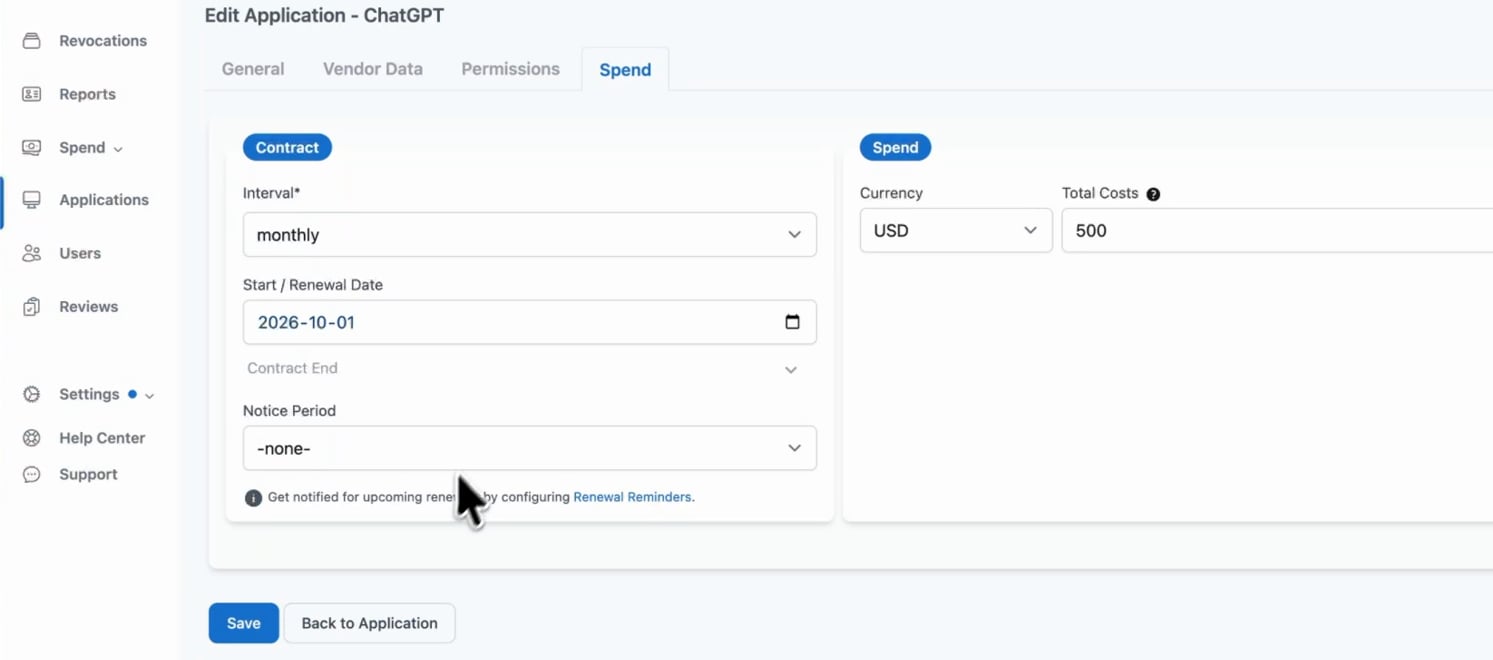
Cost per User is informational. It is shown to requesters and approvers but not used in any calculation, and it cannot vary by license or role yet. Total Costs does not change when users are added or removed.
Imported as a CSV
To see how spend develops over time, import the actual payments. Export the transactions from your accounting tool, bank, or card provider and upload them under Spend. AccessOwl matches each payment to one of your applications by its description. See Import Expenses from a CSV for the step-by-step procedure.Not Filled Automatically
There is no live connection to an accounting or ERP system today. Every figure arrives through manual entry or a CSV import.Import Expenses from a CSV
Expense records are the individual line items from your bank statement or accounting export. Each import needs four columns: date, amount, currency, and description. Expenses must be negative amounts, positive amounts are treated as credits. A sample file is linked in the import dialog if you want to check the format first.1
Open the Expense Records page
In the admin interface, go to Spend > Breakdown and click Manage expenses. This opens Expense Records, the list of every payment you have imported so far.
2
Start the import
Click Import. Drop your Excel or CSV file into the dialog, or click Or click here to copy paste table data to paste rows straight from a spreadsheet.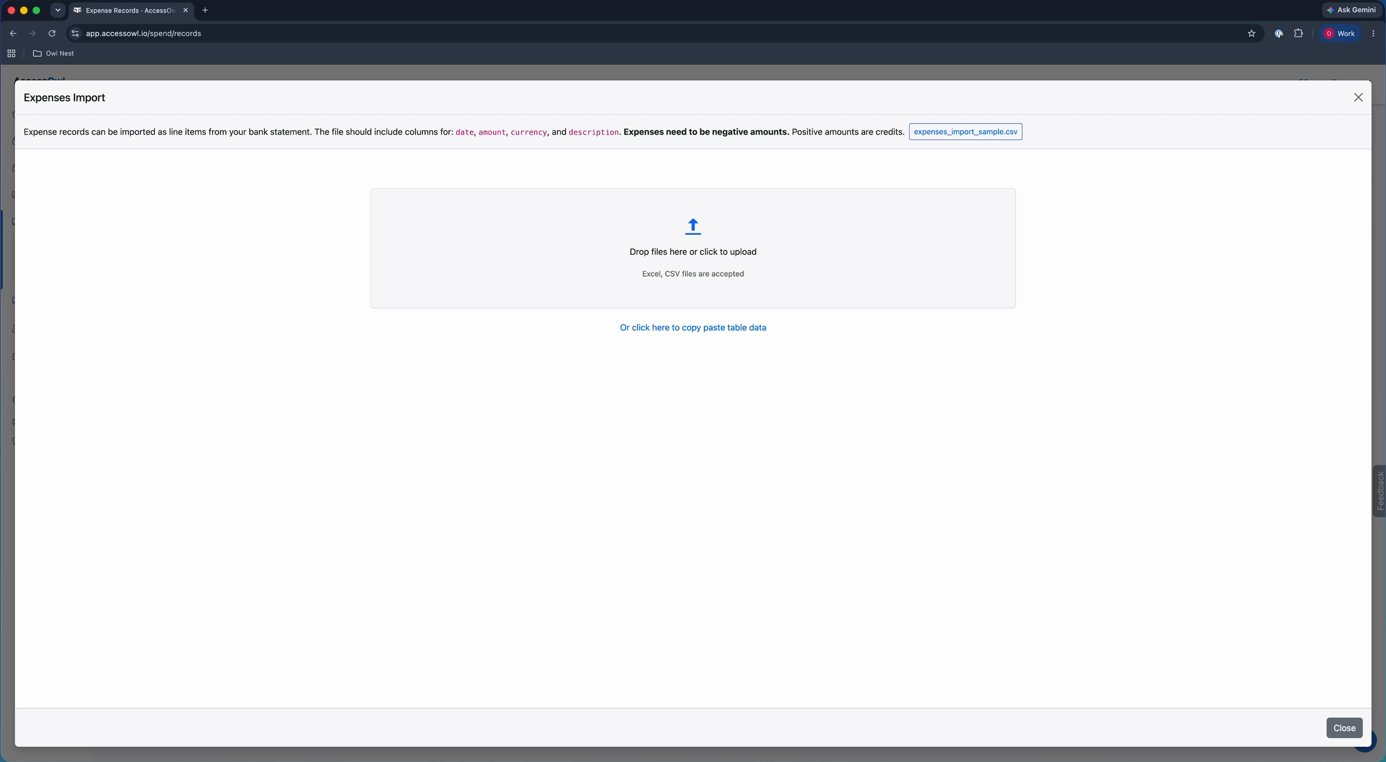
3
Select the header row
AccessOwl shows a preview of your file. Confirm the row that holds the column names, or tick No headers in the sheet if your export has none. If the file uses a different encoding, change it from the dropdown in the top left. Click Next.
4
Map the columns
Match the columns in your file to Payment Date, Amount, Currency, and Description. AccessOwl pre-selects the mapping when the column names are recognizable. Click Next.
5
Verify and submit
Review the parsed rows. The Invalid counter shows rows AccessOwl could not read, and Find and Replace lets you fix a recurring issue across the whole file. Remove rows you do not want with the X at the end of the line, then click Submit. Keep the browser window open until the import finishes.
6
Check the results
Back on Expense Records, each payment carries a status. Matched payments are linked to one of your applications. Unmatched payments have no application yet, link them to the right application from the record’s actions menu so they count toward that application’s spend. Payments you do not want to track can be marked as Ignored. Use the filters for application, payment month, and source, or search by description, to work through the list.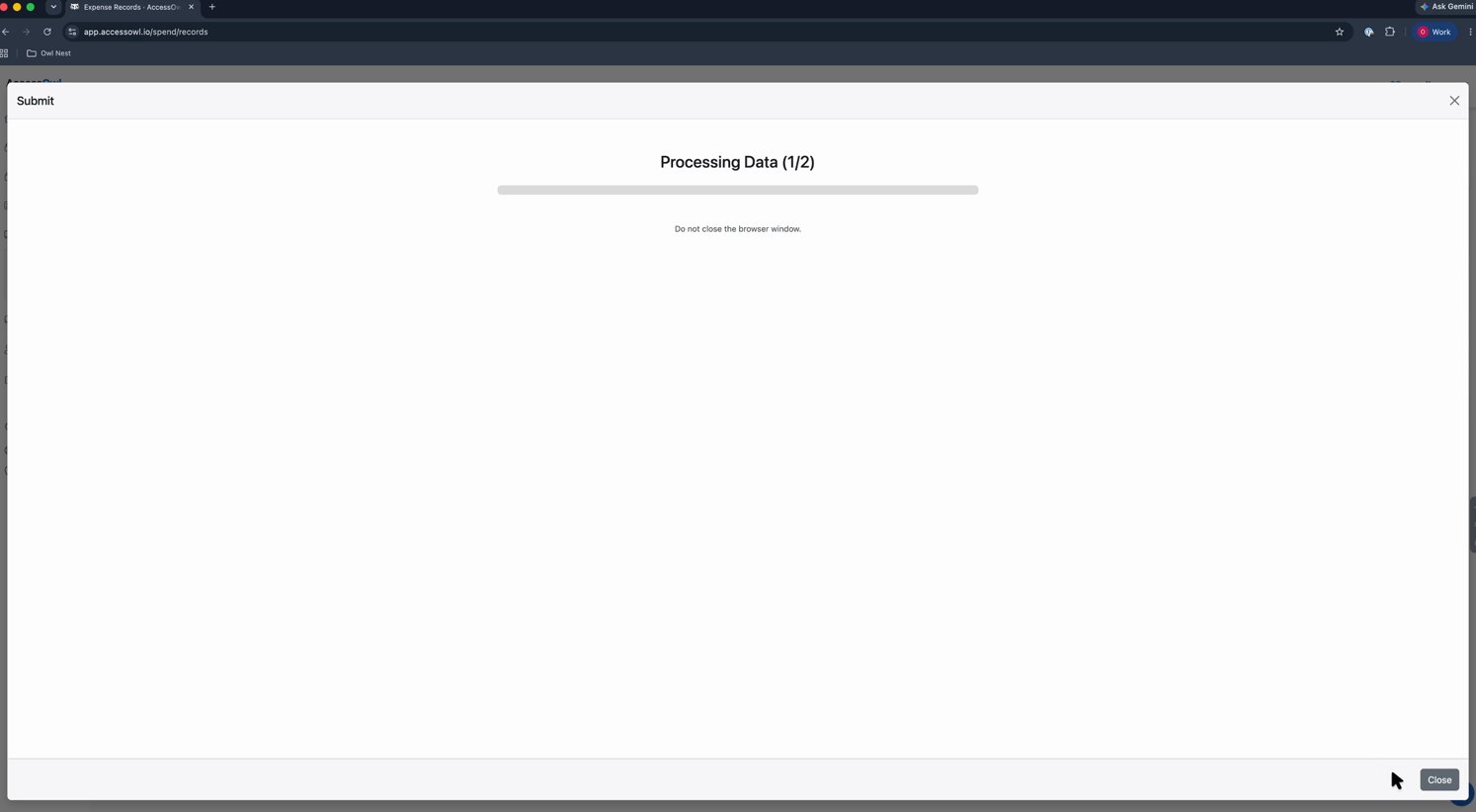
Renewal Reminders and the Renewal Calendar
Once an application has an interval, a start date, and a notice period, AccessOwl knows the last day you can still cancel and reminds the right people before it passes.1
Enter the contract terms on each application
Fill in the Contract card on the application’s Spend tab as described above. The notice period matters most. It is what turns a renewal date into a deadline for your decision.
2
Configure Renewal Reminders
Go to Settings > Notifications and open the Renewal Reminders section. Choose how far ahead of the cancellation deadline you want to be reminded, from one week to two months, and who receives the reminder. Reminders go to the application’s Business Owner by default and are delivered in Slack. You can also add Org Admins and Application Admins as recipients.
If an application has no Business Owner, its renewal reminders are sent to the Org Admins instead.
3
Review upcoming renewals in the Renewal Calendar
Go to Spend > Calendar to see every renewal across your applications, month by month. See The Renewal Calendar below.
The Renewal Calendar
The Renewal Calendar is the overview of everything that is about to renew. It lives under Spend > Calendar, and the dashboard shows a count of upcoming renewals that links to it. The page shows one tile per month for the selected year. Each tile lists how many renewals fall in that month, what they add up to per year, and the icons of the applications involved. Click a month to open the table below it, which has one row per renewal:- Upcoming Renewal, the exact renewal date
- Application, with the number of users who currently hold access
- Annual Costs, the yearly figure derived from the application’s spend
- Billing Cycle, the interval you entered on the application
- Risk-Level, from the application’s vendor data
- Business Owner, the person who receives the renewal reminder
Who Can Add Spend Data
Cost and contract details on an application can be edited by Org Admins and the application’s Business Owner. Everyone else sees the cost per license on access requests but cannot change it.You can hide the cost per license from requesters and approvers in your global settings if you do not want the price shown during requests.
Current Limitations
- One cost per user per application. The cost shown on a request cannot vary by role or license tier. For applications with tiered pricing, enter the cost most users land on.
- Costs are not calculated. Cost per User is display only, and Total Costs does not change when users are added or removed.
- The spend breakdown has no export. It is built for analysis inside AccessOwl. To share the figures with someone outside AccessOwl, use the Applications export or a screenshot.
- Cost and contract fields are not available through the REST API. The applications endpoints return vendor and access data but no cost, currency, billing interval, or renewal dates.
Get Started with Spend Management
1
Check that the module is enabled
Spend Management is an add-on module. Open the Spend menu in the admin interface. If it opens a page describing the module and how to unlock it, the module is not enabled for your organization yet. Use the contact option on that page or your shared Slack channel with AccessOwl to have it enabled.
2
Add costs and contract terms to your applications
Start with the applications that matter most to your budget. Open each one, click Edit, and fill in the Spend tab with the interval, start date, notice period, currency, and costs. Make sure each application has a Business Owner, since renewal reminders go to them.
3
Turn on Renewal Reminders
Go to Settings > Notifications and set when and to whom renewal reminders are sent. See Renewal Reminders and the Renewal Calendar.
4
Import your first expense export
Export the last months of SaaS transactions from your accounting tool, bank, or card provider and follow Import Expenses from a CSV. Link any Unmatched payments to their application so the breakdown is complete.
5
Decide what requesters see
By default, requesters and approvers see the cost per license on every access request. Keep it on to give approvers a cost signal, or turn it off in your global settings.